Understanding Mailroom Management Models for Complex Campus Environments
Praveen kumar SApril 9, 2026

Modern campuses would rather be corporate parks, hospitals or universities. When it comes to multi-building modern campus facilities, the conventional single-fit-all mailroom management system is no longer effective. Regardless of whether it's an MNC or a NAAC high-grade accredited university, parcel volume has reached a tipping point that has outpaced physical infrastructure. According to recent studies, industry data have confirmed that internal distribution has shown the highest number of ecommerce purchases.
A recent Deloitte research focuses on how real-time tracking has become a basic need of organisations for lowering order queries. Thereby, with the increasing ecommerce and internal logistics, managing mails across different distributed environments has become a strategic function. The present-day modern campus mostly focuses on last-mile delivery and timely parcel arrival within the campus. Within such distributed environments, organizations required a fast and secure mailroom management system across buildings.
In this blogpost, we are going to focus on the multiple challenges of multi-building mail management and how the core mailroom models of the courier management system are becoming a game-changer in the sector.
What are the challenges involved in multi-building mail management?
A multi-building campus mainly introduces logistics-related complexities that are unavoidable. From high-parcel volumes from multiple carriers to distinct delivery points and access protocols, the intricacies have their own uniqueness. Manual processes may often tend to delay sorting and routing. Likewise, the system faces inefficiency due to a lack of real-time visibility for recipients. Without a structured system, packages mostly get delayed, lost and misplaced.
Core mailroom management models
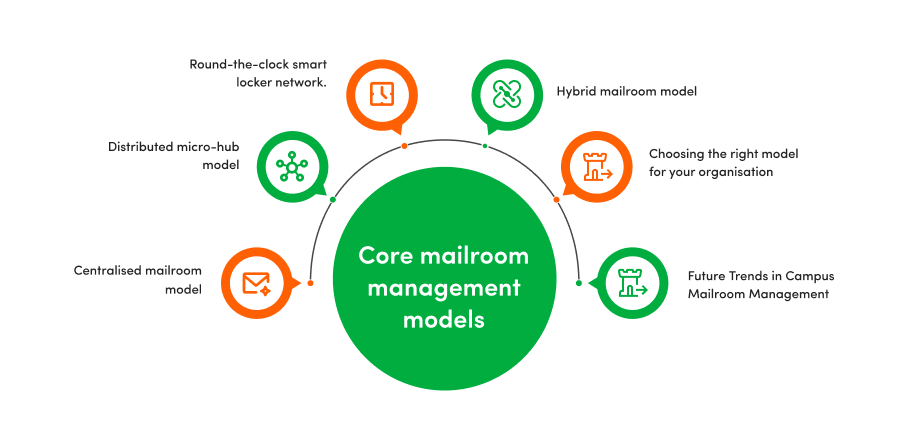
Centralised mailroom model
In this model, different incoming mail and packages are delivered to a central mailroom. From there several products are sorted and distributed to distinct buildings. The process involves carriers delivering to a single location, staff sorting and routing parcels instantly. The scheduled deliveries are created across campus. The major advantages of the mailroom model involve mailroom improved control and security, seamless tracking & accountability, and cost-effectiveness through centralized staffing. This is highly suited for large campuses with structured internal transport systems.
Distributed micro-hub model
It helps in obtaining all parcels within a centralized location dock and instantly shuttling them to strategically placed satellite locations. The micro-hubs are situated across high-density areas like a departmental wing. Supporting the workflow, it offers bulk arrival at a central dock to zone sorting to final-mile shuttle and pickup. The mailroom management system is highly favourable for campuses with diverse high-traffic residential and office clusters. It lowers recipient travel distance and keeps high-volume sorting away from public areas.
Round-the-clock smart locker network.
In place of establishing physical rooms with staff, several campuses are opting for a locker-first approach. The modular units are situated in outdoor common areas, building lobbies, and parking structures for administering contactless access. Employees can scan parcels into lockers for automating QR code notification to round the clock recipient retrieval. This mailroom management model is influential for hybrid employees and students who require access outside of standard business hours.
Hybrid mailroom model
The hybrid model mainly amalgamates the strengths of both centralized and decentralized systems. As a central hub, it manages bulk sorting, while localising distribution points can tackle last-mile delivery. On a functional approach, it works with the central mailroom receiving and processing all parcels. With smart routing, it sends products to building-level hubs. Having the final delivery, it happens locally or through lockers. The core advantages involve a balance of efficiency and speed, advanced tracking across different stages and scalability with campus growth. This mailroom management model is effective for tech-enabled campuses that are aiming for automation and scalability.
Choosing the right model for your organisation
For a multi-building campus, facility managers need to choose the right mailroom model for balancing scalability and manpower. Evaluating certain factors like assessing campus size and layout, evaluating parcel volume and delivery frequency, defining delivery speed expectations, budget and resource availability, identifying security and compliance needs, and planning for scalability are essential for getting the ideal model for your organization. The process of selecting the right model depends on core factors which involve campus size, parcel volume, user expectations and budget and resources. Promoting a thoughtful assessment ensures the selected model aligns properly with both operational objectives and user requirements.
Future Trends in Campus Mailroom Management
Coming to operational scalability, consistency and visibility are considered key aspects. The future of mailroom management software is completely shaped by innovation, and for multibuilding modern campuses, it is hybrid. Popular trends in mailroom systems involve AI-driven sorting and demand forecasting, autonomous delivery robots within campuses, sustainable packaging & green logistics, and contactless delivery ecosystems.
Conclusion
For modern campuses that are aiming to scale efficiently, meanwhile delivering a seamless experience, a hybrid and technology driven model is constantly becoming the gold standard. With the process of aligning your mailroom strategy with your campus structure and other future objectives, one can transform mail management from a logistical challenge into a great advantage. Having a unified mailroom management software optimizes campus mailroom processes and also ensures that every parcel reaches its recipient on time. As a premier mailroom tracking software, Khayash is specially designed to meet end-goals of organisations that are focused on scalability. It simplifies mailroom infrastructure by bringing transparency, visibility and control into a single unified platform. With real-time parcel tracking, smart notifications, centralized dashboard, multibuilding support, secure audit trails, and many more, Khayash becomes a real game-changer in the mailroom management model.
Frequently Asked Questions

